That's the procedure from the '69 Imperial FSM:
View attachment 54911
VOLTAGE REGULATOR TEST
(1) Check the battery specific gravity. It should be
above 1.200 to allow a prompt regulated voltage
check. If the specific gravity is below 1.200, charge or
use another battery and do not leave uncharged battery
in circuit.
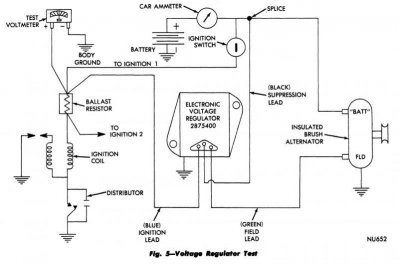
(2) Connect the positive lead from a voltmeter to
the IGN 1 terminal of the ballast resistor. The IGN
1 terminal of the ballast resistor is the end which has
one or two blue wires connected to it. The other end
(IGN 2) will have a brown and blue wire or just a
brown wire connected to it.
(3) Connect the negative lead from the test voltmeter
to a good body ground.
(4) Start and operate engine at 1250 RPM with all
lights and accessories turned off. Check voltage. It is
normal for the ammeter to show an immediate charge,
where-in the hand will swing over to the right and
then gradually return to normal position. The duration,
the ammeter hand remains to the right will bedependent on the length of cranking time.
(5) If the instrument panel ammeter deflected less
than 1/4 scale towards charge in step 4, turn on headlights
high beam and heater fan on high. If deflection
was greater than 1/4 scale, only turn on heater fan
on high. Check voltage. The voltage regulator is working
properly if the voltage is in accordance with the
following table for both checks:
Ambient Temperature Near
Voltage Regulator Voltage Range
-20 F 14.3—15.3
80 F 13.8—14.4
140 F 13.3—14.0
Above 140 F Less than 13.8
(6) If the voltage is below limits, proceed as follows:
(a) Check for a good voltage regulator ground.
Check for voltage drop between cover of voltage
regulator and body on low voltage scale of voltmeter.
(b) Turn off ignition switch and disconnect voltage
regulator connector.
(c) If it has been determined that the alternator
is working, check for battery voltage present at wiring
harness terminals connected to black and green
leads. Also turn on ignition switch but do not start
car, and check for battery voltage at wiring harness
terminal connected to blue lead. Turn off ignition
switch.
If any of these voltages are not present the problem
is in the vehicle wiring. CAUTION: Do not distort
terminals with voltmeter probe.
(d) If the previous steps (6a thru 6c) are satisfied.
Change the voltage regulator and repeat step 5. Always
use proper mounting screw.
(7) If the voltage is slightly above the limits or
fluctuating proceed as follows:
(a) Check ground between voltage regulator and
body and between body and engine.
(b) Clean battery terminals and recheck voltage.
(8) If the voltage is more than one-half a volt above
limits change voltage regulator. Repeat step 5 using
the new regulator. Remove test voltmeter.
View attachment 54912