Brake pressure disappears after starting the car.

Sander80

New Member
Joined
Aug 20, 2023
Messages
8
Reaction score
4
Location
Netherlands
Hi all,


First of all my apologies for my grammatic, English isn't my first language.


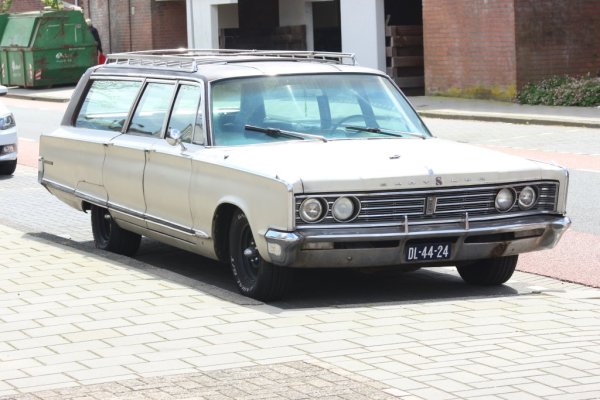
I have a question for you guys, I have a '66 Town & Country and it's having brake issues.

The car has front and rear drums,There was a problem before I started working on the cars braking system, but it seems to get worse then it was.
The car had issues that the brake pedal would lose pressure after braking a few times, after a brake inspection I found quite a lot of things wrong on them.
The shoes where cracked, very crusty brake line, broken bleed nipple and of course the pressure thing when braking. But at that time it lost all braking power when the engine stalled.

What did I do:

I replaced all brake shoes, drums, small bits and pieces in de brakes, wheel cylinder, brake lines, master brake cylinder. I've upgraded the brake cylinder to a double brake line version, the original had 1 connection and I wanted that more modern.
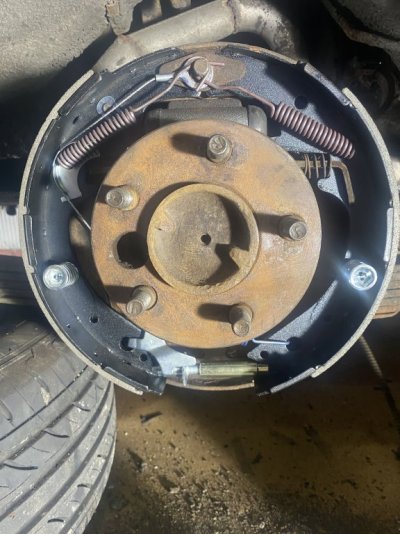
20250623_144826239_iOS.jpg


So now, when the engine is off, I have quite a sturdy brake pedal and it feels decent. When I start the engine I lose all pressure, i hold the pedal the same when starting but the pedal goes to the bottom.
When I shut the engine down it regains pressure. I've checked for leaks, I've bleeded the brakes, checked the fluid level, I've checked the booster valve on the brake booster and I've checked the vacuum from the engine to the brake booster.

When I start the car with the vacuum disconnected it keeps it's pressure, when I connect it loses power.

My guess would be a bad brake booster, but I would like to hear some of your input as this is my first American classic. I used to work on old European cars.
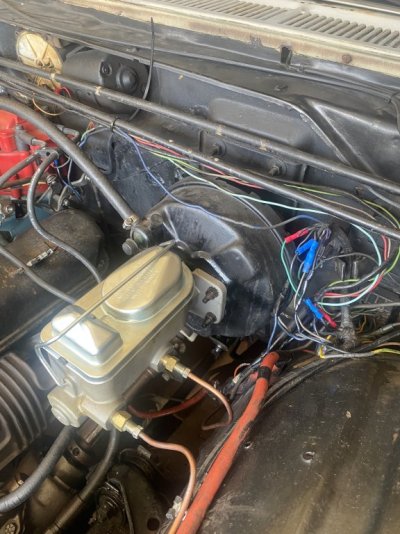
20250811_124002286_iOS.jpg (and yes, the wiring looks terrible,I had to find some issues).


Thanks for your time and greetings from the Netherlands.
IMG_1620.JPG
 
Question, are you loosing braking or does the peddle just go down when the booster is connected? Normally if you have your foot on the brake and start the car the peddle will go down some as it is getting assistance from the booster. It should not be going down to the floor, normally just an inch or so.
 
I see one problem it looks like you have a disc brake master cylinder on the car. The drum master cylinder will have the same size reservoir front and rear, the one you installed has a big one, for the front discs and a small one for the rear drums.
1755011989753.png

1755012167272.png
 
Last edited:
I see one problem it looks like you have a disc brake master cylinder on the car. The drum master cylinder will have the same size reservoir front and rear, the one you installed has a big one, for the front discs and a small one for the rear drums.
View attachment 730637
View attachment 730638
Thanks, that could be a part of the issue maybe. although it should let the pedal drop the the bottom right?

Ill search for the right one, thanks for the information.
 
Question, are you loosing braking or does the peddle just go down when the booster is connected? Normally if you have your foot on the brake and start the car the peddle will go down some as it is getting assistance from the booster. It should not be going down to the floor, normally just an inch or so.
It keeps a very little braking power. I can push the car true the brake when someone's braking with the engine on and vacuum connected. The pedal drops more then a inch for sure.
 
I would first start out by changing that master cylinder to the correct one AND make sure your linkage going from the booster to the master cylinder is the the correct length. If it is to long it will hold pressure on your brakes even when the peddle is released. If it is to short it might cause to much brake peddle movement.
 
IF the pedal goes to the floor, by itself, when starting the car with an "empty" booster, that is an internal booster issue. NOT a master cyl issue. The main difference between a disc brake master cyl and a drum brake master cyl is the internal residual pressure valves. I don't recall which system gets the residual pressure valves, but I'm sure Google can provide an answer.

In the earlier days of disc brakes, the fluid volume of the calipers was greater than the wheel cylinders, so the larger reservoir section readily indicated a disc brake master cyl. Which was probably a very good thing on the assy line! Easy ID!

The Chrysler Factory Service Manuals can be free-downloaded at www.mymopar.com (might have to manually input that address).

Please keep us posted on your progress,
CBOYD67
 
I see one problem it looks like you have a disc brake master cylinder on the car. The drum master cylinder will have the same size reservoir front and rear, the one you installed has a big one, for the front discs and a small one for the rear drums.

I'm gonna have to call you out on this - that drum master cylinders have same size reservoir.

Here is the original and replacement (in 2022) MBC's for my '67 Monaco. 4-wheel drum.


mbc-1.jpg


These are not very tall, the reservoirs are not very deep. The replacement does look to have a more equal-size front and back.

I was under the impression that MBC's for disk brakes were TALLER than the MBC's for drum brakes, they contained more fluid (because disk brakes are not self-adjusting, well I guess they are in a way, but not the same way as shoes) and usually had the wire hold-down instead of a bolt.

It does look like @Sander80 has a an MBC and booster setup for a front disk brake car.

Which would be a first I would think. A disk-brake MBC/booster setup on a 4-wheel drum car. I would think the front drum brakes would be very over-powered with that. I don't know exactly what booster is on that car, but it's not a slab-era booster.

I think that's a 318. An LA 318 (not a poly). So that's not the original engine for that wagon. I have the same exhaust manifolds (which are from the 70's).
 
Last edited:
I don't know exactly what booster is on that car, but it's not a slab-era booster.
That actually is a slab-era booster, I've got it on mine and I've seen it on other cars that were made at Newark. It's a 9" Bendix single diaphragm booster. Mines getting rebuilt, well WAS getting rebuilt, the core is un-rebuildable and they are having a hell of a time finding another that is in rebuildable condition . . . but that's another story.
 
As far as I know, this is a 4-wheel-drum slab-era booster:

1622.jpg


I think same booster for single-chamber in 1965/66 and dual-chamber 1967 and to maybe 69?
 
Yes, wrong master cylinder for sure - it should look like this https://www.rockauto.com/info/142/130.63009_Angle.jpg
And then honestly that booster is probably bad - do you hear any "hissing" from inside the car when you apply or release the pedal? Any change in engine idle quality when you apply the pedal?

Also, I see a small block! Very interesting.
Hi, thanks for the reply, there is no hissing sound when using the brake pedal, idle stays the same but it runs a bit harder as usual with a cold start because the car runs on propane gas (that's pretty common here for old American classics in Europe). And yes, the engine is a 318, a previous owner swapped the 383 with a 318. I'm looking around for one, I don't mind rebuilding one myself, but a non runner, rebuildeble 383 sells for 3-4k here. As I have many things on the cars todo list, the running 318 is not a big of a priority yet.
 
Hi, thanks for the reply, there is no hissing sound when using the brake pedal, idle stays the same but it runs a bit harder as usual with a cold start because the car runs on propane gas (that's pretty common here for old American classics in Europe). And yes, the engine is a 318, a previous owner swapped the 383 with a 318. I'm looking around for one, I don't mind rebuilding one myself, but a non runner, rebuildeble 383 sells for 3-4k here. As I have many things on the cars todo list, the running 318 is not a big of a priority yet.
When you are looking for that 383 for a swap make sure you get a big block transmission also because they are different bolt pattern.
 
I'm gonna have to call you out on this - that drum master cylinders have same size reservoir.

Here is the original and replacement (in 2022) MBC's for my '67 Monaco. 4-wheel drum.


View attachment 730674

These are not very tall, the reservoirs are not very deep. The replacement does look to have a more equal-size front and back.

I was under the impression that MBC's for disk brakes were TALLER than the MBC's for drum brakes, they contained more fluid (because disk brakes are not self-adjusting, well I guess they are in a way, but not the same way as shoes) and usually had the wire hold-down instead of a bolt.

It does look like @Sander80 has a an MBC and booster setup for a front disk brake car.

Which would be a first I would think. A disk-brake MBC/booster setup on a 4-wheel drum car. I would think the front drum brakes would be very over-powered with that. I don't know exactly what booster is on that car, but it's not a slab-era booster.

I think that's a 318. An LA 318 (not a poly). So that's not the original engine for that wagon. I have the same exhaust manifolds (which are from the 70's).
Hi there, the engine should be from a 68-69 Plymouth Satellite 3 (that's what the've told me) the original engine was a 383 4bbl. hopefully one day i'll find one here in Western Europe.

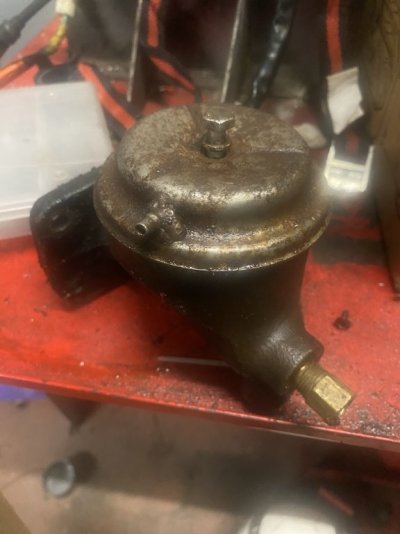
My original master cylinder was this one:

20250813_115223249_iOS.jpg

But it doesnt work properly.

The one I have now has been sold by a local company that repairs US cars, I had the hope he ordered the right one, but it seems like it's not the right one for now, until I do a disc brake conversion.


With kind regards,
Sander
 
Hi there, the engine should be from a 68-69 Plymouth Satellite 3 (that's what the've told me) the original engine was a 383 4bbl. hopefully one day i'll find one here in Western Europe.

My original master cylinder was this one:

View attachment 730712

But it doesnt work properly.

The one I have now has been sold by a local company that repairs US cars, I had the hope he ordered the right one, but it seems like it's not the right one for now, until I do a disc brake conversion.


With kind regards,
Sander
As well meaning as your source might be, there was no "Satellite 3" in the USA, but a FURY III, which is a companion C-body car. 1965s had a unique lh engine mount, but 1966+ have the "standardized" lh engine mount.

If you now have the LA318, identifiable by a smooth lower valve cover stamping rather than the zig-zap offsets of the Poly 318, plus the many differences to make a LA318 fit into the same place the former 383 was, it might be less expensive to do a 408 stroker for your motor. That way, no chasing parts to keep the engine where it now is. Then get the existing 904 TF rebuilt with stronger aftermarket components for better longevity, unless it might be a LA318/360-case 727.

If the issue of the residual pressure valve is understood and verified, there is NO reason the non-equal reservoir sized master cyl will not work well on a 4-whl drum brake vehicle. Once the minimum fluid capacity requirements are met, anything else is "gravy". Checking the piston diameter in the master cyl would be more important, on a 4-whl drum brake car, I suspect.

Enjoy!
CBODY67
 
Hi all,


First of all my apologies for my grammatic, English isn't my first language.


I have a question for you guys, I have a '66 Town & Country and it's having brake issues.

The car has front and rear drums,There was a problem before I started working on the cars braking system, but it seems to get worse then it was.
The car had issues that the brake pedal would lose pressure after braking a few times, after a brake inspection I found quite a lot of things wrong on them.
The shoes where cracked, very crusty brake line, broken bleed nipple and of course the pressure thing when braking. But at that time it lost all braking power when the engine stalled.

What did I do:

I replaced all brake shoes, drums, small bits and pieces in de brakes, wheel cylinder, brake lines, master brake cylinder. I've upgraded the brake cylinder to a double brake line version, the original had 1 connection and I wanted that more modern.

View attachment 730631


So now, when the engine is off, I have quite a sturdy brake pedal and it feels decent. When I start the engine I lose all pressure, i hold the pedal the same when starting but the pedal goes to the bottom.
When I shut the engine down it regains pressure. I've checked for leaks, I've bleeded the brakes, checked the fluid level, I've checked the booster valve on the brake booster and I've checked the vacuum from the engine to the brake booster.

When I start the car with the vacuum disconnected it keeps it's pressure, when I connect it loses power.

My guess would be a bad brake booster, but I would like to hear some of your input as this is my first American classic. I used to work on old European cars.

View attachment 730632 (and yes, the wiring looks terrible,I had to find some issues).


Thanks for your time and greetings from the Netherlands.

View attachment 730633
If the master cylinder one way restrictor valves located where the brake line connects to the master that hold the shoes close to the drum when you let off the pedal are bad and not holding return pressure the shoes will retract all the way in when the pedal is released. Then the master will have to move them all the way out each time the pedal is pressed to make contact with the drum before any braking happens or any resistance is felt at the pedal.
The resistance you feel with the engine off may be just (and only) the resistance from the springs on the shoes if the shoes are way to far in. Or it may be just (and only) the resistance from the springs in the master if the shoes are in to far.

Do the brakes stop the car with the vacuum to the booster disconnected when driving?
Are you sure your master to booster connecting rod is the correct rod and adjusted to the right length?
Did you bench bleed the master when you installed it?

Drum restrictors are 2 psi and disc restrictors are 10 psi, I think? Or the other way around, I think?
 
If the master cylinder one way restrictor valves located where the brake line connects to the master that hold the shoes close to the drum when you let off the pedal ...

The residual pressure valve (RSV) is said to provide at most 10 psi to keep the wheel cylinder seals engaged against the pistons to prevent air from entering the cylinder during pedal release. This 10 psi pales in comparison to the 75 psi holding force that the shoe return springs have.

Brake shoes with properly working auto-adjusters (the star wheel) will always set themselves to minimal clearance against the drums to prevent excessive pedal travel to engage the brakes as shoes wear. There are also RSV's for disk brakes, their pressure is set much lower (like 2 psi) and this is really to keep the pistons from retracting too far, mainly it is said for off-road situations where vibration effects can back-off the piston inside the caliper. Now this is for aftermarket situations, you can get these RSV's that install in-line. Normally you wouldn't think a disk-brake piston would need a positive holding pressure and you wouldn't think it would be good for the pads.

What exactly the 60's / 70's MBC's came with from the factory in terms of RVP's I don't know. Did all MBC's, even the old single-chamber ones, have built-in RPV's ?
 
The resistance you feel with the engine off may be just (and only) the resistance from the springs on the shoes if the shoes are way to far in. Or it may be just (and only) the resistance from the springs in the master if the shoes are in to far.
I asked him if the brakes were adjusted and I never got an answer.

It seems to me that could be the cause, but until that simple question gets answered, we'll never know.
 
Back
Top