question on firm feel box

stain

Active Member
Joined
Apr 23, 2014
Messages
259
Reaction score
272
Location
vt
I recently changed my steering box out with a stage 1 firm feel box. To me, the steering feels" rubbery". It is definitely stiffer. In fact, when at idle and the car in park, it is a struggle to turn the wheel.
After install I turned the wheels side to side to purge the air. I also aligned the car. I have driven the car @500 miles since the install in hopes the box might "wear in"?
Just asking if this is the way this stage one box feels for others, or do I have a problem?
Could there still be air after all that mileage?
 
Which vehicle? "Rubbery" but stiffer?

The effort at idle can be a result of the power steering pump not having enough capacity/boost at lower rpms. Due to pulley diameter, possibly? Possibly a smaller pulley from an earlier model might help to run the pump faster at idle speed?

Just some thoughts,
CBODY67
 
Sorry, 68 New Yorker
Pump was rebuilt under PO. Original pump and pully.
There was no problem before the box swap.
Original P/S box was leaking everywhere.
New box, pitman arm, rebuilt steering coupler.
By rubbery, I mean i turn the wheel at speed and I feel resistance, but the car doesn't seem to respond. Then a little more input and it all catches up at once. it does not seem as linear as the factory box was.
Maybe the nature of the new box? I have nothing to compare it to except how it was before the new stock box.
 
Thanks for the additional information. If the pump is original to the car, then the pulley should be the size it needs to be, unlike Formals with their larger pulleys. OR at least they look to be larger with three or so spokes in them, to me.

When was the last time the toe-in was checked? What air pressure in the front tires"? Radials? Just curious.

The "resistance" you are feeling is a "firmer feel" calibration in the gearbox, I suspect. As if it has less total boost to assist turning the steering wheel.

If you "ease" the wheel in a turn, is the response the same for the steering wheel input? Or is it linear?

Might the unusual feel be due to the new steering coupler?

Just curious,
CBODY67
 
I recently changed my steering box out with a stage 1 firm feel box. To me, the steering feels" rubbery". It is definitely stiffer. In fact, when at idle and the car in park, it is a struggle to turn the wheel.
After install I turned the wheels side to side to purge the air. I also aligned the car. I have driven the car @500 miles since the install in hopes the box might "wear in"?
Just asking if this is the way this stage one box feels for others, or do I have a problem?
Could there still be air after all that mileage?
I have a Stage 2 Firm Feel steering gear in my 1970 Fury. Although it is "modern feel", I do not struggle to turn the wheel in idle or park.
I suspect there is air still in the system. Your steering should not have to catch up to your input. Effort should be linear.
Bleed: Did you have an assistant turn the steering wheel side to side, while you watched the power steering pump? If not, how do you know all the air is gone?
It's either air, or you made a mistake installing control valve on the valve body.
Firm Feel is good about answering questions over the phone.
 
Last edited:
I did the alignment myself at work.
The valve body was attached on the box when delivered.
I would have thought the air would have come out after 500 miles but i will have another shot at bleeding.
 
Might need to pull a vac on the ps system to get all of the air bubbles out.

Just suspectin',
CBODY67
 
I did the alignment myself at work.
The valve body was attached on the box when delivered.
I would have thought the air would have come out after 500 miles but i will have another shot at bleeding.

ADVICE ON STEERING BOX SPOOL VALVE

From another recent thread, may help. The Chevelle link, post three.

I agree with the post below. We had wheels in air, engine off. I remember my wife had to turn the wheels side to side a bunch of times to get all the air out.

"Edit: some suggest turning lock to lock up to 10 times, with wheels in the air, engine off, as the best way to purge air. If engine is running, with wheels on the ground, air can / will get whipped up into a froth with the PS fluid and will take a while to separate, possibly have to wait hours or overnight."

I had to install the control valve front of valve body. My notes from 2023-02-10 are below.
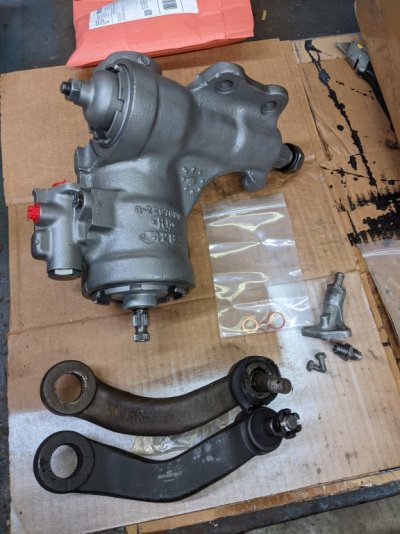
PXL_20230202_200130459.jpgPXL_20230210_151659616.jpg
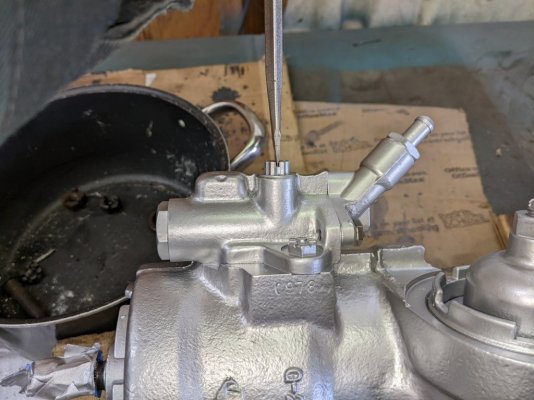
Return valve/control valve FSM 19: the front of the valve body came from Firm Feel with 2 plastic plugs in place. Before doing anything, turn the steering gear so that the valve body faces up. Otherwise once I pull the plugs, power steering oil that’s in the valve body starts to spill out. Coat 2 O-rings with Sil-Glyde. The larger O-ring goes in the indent in the front of the valve body. The smaller O-ring goes in the indent in the back of the control valve. Install control valve with 2 bolts that were returned by Firm Feel. 7/16 inch short socket, 3 inch extension, 1/4 inch ratchet, then torque at 95 inch pounds with 3/8 torque wrench.
Pressure hose fitting at valve body: came back with steering gear from Firm Feel. After positioning the steering gear so that the valve body faces up and using a screwdriver to remove the plastic plug at the top of the valve body, install fitting with copper washer also provided, 11/16 long socket, 3/8 torque wrench at 30 foot-pounds.

Sounds like you are a mechanic if you did the alignment, but still, I never had the problems you are having, so the above may help.

 
I recently changed my steering box out with a stage 1 firm feel box. To me, the steering feels" rubbery". It is definitely stiffer. In fact, when at idle and the car in park, it is a struggle to turn the wheel.
After install I turned the wheels side to side to purge the air. I also aligned the car. I have driven the car @500 miles since the install in hopes the box might "wear in"?
Just asking if this is the way this stage one box feels for others, or do I have a problem?
Could there still be air after all that mileage?
I also have a Stage II box in my '70 300. While it's not a struggle to turn the steering wheel while parking, it is a little stiffer and for someone that's used to the usual Chrysler assist where you can spin the wheel, it seems funny at first.

On the highway, it's good. Maybe a touch more effort, but better "road feel".

I had a problem bleeding the PS after I changed the pump in my Barracuda. It would intermittently show up, especially when parking. You'd spin the steering wheel and it would suddenly get stiff and then release. The issue turned out to be a small leak in the return hose. Once tightened and the bleed procedure followed, it was fine.

Here's something from the folks that rebuilt my pump. Note line #6. You didn't note what pump you have, but also see the bottom sentence about Saginaw pumps if that's what is on your car.

Suggestions for Filling Your Power Steering System — Powersteering.com
 
Study the effect that the reaction springs and reaction spring washers in the box power train have on the effect of the steering assist response.
If soft reaction springs are used, then the effort to turn the wheel will be increased at all speeds and rpm and the steering assist will be delayed because of more travel needed to move the control valve that is mounted on top of the box. The cure for that is a custom reaction spring power train with altered valve spacing that applies boost pressure to the worm power train sooner to reduce wheel free play. Result, firm feel by way of reduced power assist.

Also get an understanding of the fluid return pressure valve located at the return line attachment on the control valve associated with the box itself. That controls the amount of available assist pressure that the worm shaft (pitman shaft) power train sees.

And then there is an rpm sensitive bypass valve AT THE PUMP that dumps fluid/pressure back to the pump and limits flow/pressure TO THE BOX above 1500 rpm, so the pump doesn't overheat at road speed.

Personally, I don't need or want to feel anything through the steering wheel or fight the bump steer that comes with reduced power assist, or to apply any extra effort to steer the car. I drive by what I see with my eyes and feel with my butt. So, I use the stiffest reaction springs I can get. That brings in more assist sooner rather than less later and it also reduces steering wheel free play.

If "when at idle and the car in park, it is a struggle to turn the wheel" something is wrong.

Reaction springs.
Pump valve.
Control box valve.
Air? Maybe. I don't think so. Not in the absence of noise?

I don't suspect the adjustable centering control assembly itself.

The effort to make a vintage Chrysler recirculating ball power steering box feel and behave like more recent power rack and pinion is an admirable one at best. The reaction spring engineering design doesn't allow for that.

We could eliminate the power assist reaction spring setup and go for a manual box. Then things will be nice and tight with almost zero-wheel free play, require very little effort at speed and have PLENTY of road feel to boot. Especially in a parking lot.
 
There is not any noise that would indicate air.
control valve is from my old box. I did install with new gaskets, I dont see how that can be installed incorrectly, I will double check...
The effort is the same left to right.
I will check the flow valve in back of the pump
I would think air would be gone after 500 miles but maybe not.
 
Also get an understanding of the fluid return pressure valve located at the return line attachment on the control valve associated with the box itself. That controls the amount of available assist pressure that the worm shaft (pitman shaft) power train sees.
I guess I dont understand this part.
Can that valve restrict fluid return, causing hard steering?
Fluid in the reservoir is full and circulating.
I am going to have to check a few things when I get home.......
 
I guess I dont understand this part.
Can that valve restrict fluid return, causing hard steering?
Fluid in the reservoir is full and circulating.
I am going to have to check a few things when I get home.......
No. Yes. Maybe.
It's calibrated with a spring and ball.
If that valve completely fails to restrict "any" flow return, there could be no pressure in the box. So, no assist.
A partial failure would provide too much assist or to little assist.
Stuck wide open would be very little to no assist.
Stuck fully closed would blow a hose or stall the engine, but still provide some or full assist, I think?
Clear as mud, right?
 
I guess I dont understand this part.
Can that valve restrict fluid return, causing hard steering?
Fluid in the reservoir is full and circulating.
I am going to have to check a few things when I get home.......
I highly recommend that you call Firm Feel and discuss the problem with Dick Ross, the owner, or his son-in-law Frank Webster, who manages the daily business.
If you leave a phone message, they do return calls.
 
Well I"ll be dipped.
Got home, got the car in the air, turned the wheels lock to lock 6-7 times while the car is NOT running and went for a test ride. Steering was MUCH better. Steering at idle is stiff, but I can turn it. Steering feels much better down the road, more connected. No more rubbery feeling.
I never would have guessed that after @ 500 miles of driving that air could still be trapped inside the system. There could not have been much air in it as the fluid level did not go down very much.
I also tried to bleed the system while the car was running the first time.
Thanks for all responses.
 
Back
Top