1970 Brake Safety Switch Distribution Block Rebuild

1970FuryConv

Old Man with a Hat
Joined
Aug 8, 2014
Messages
6,093
Reaction score
5,931
Location
Richmond, VA
Edit: main problem is rear brake hose internally collapsed. Rebuild unneeded. See post #6.
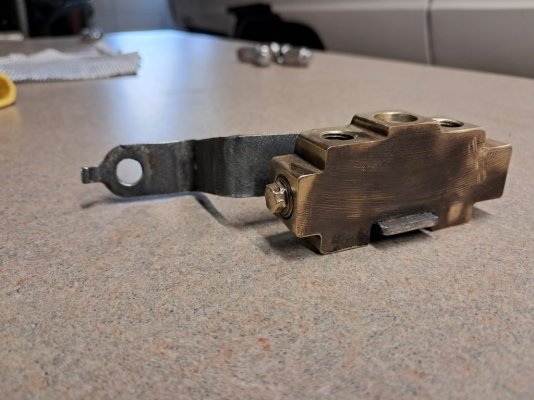
On my 1970 Fury III, I have the safety switch block pictured below.
My shop manual, says "components parts of the switch block are not serviced." p5-40.
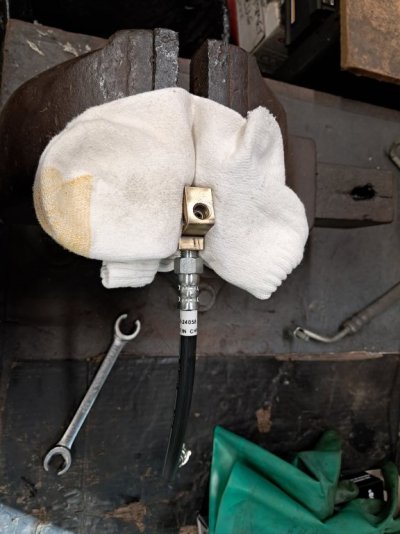
I have bunged the 5/16 head of the brass plug pictured. Because the switch block is brass, what is best way to remove this plug?
Has anyone disassembled this switch block to make it serviceable again? What procedure did you use to fix the switch block?
Thanks as always!
20250909_142654.jpg20250909_142659.jpg20250909_142713.jpg20250909_142735.jpg
No proportioning function
SSB Diagram, p5-41 FSM.jpg
 
Last edited:
It was just last week that I ordered this off e-bay:

brake-dist-block.jpg


There's a million vendors (on ebay and amazon) for this same item. It's billed as "Disc Brake Proportioning Valve & Metering Valve For Disc Drum A, B, C, E body". It was $57 USD.

This replicates the combination distribution-block / rear-brake hold-off valve found on the first disk/drum cars. The larger piece looks exactly like the stock drum-drum distribution block with brake-light switch. The bracket is, of course, not correct for a C-body, but you won't find this item, with or without the smaller hold-off valve, with the correct C-body bracket being reproduced. But that's ok, I can rig up a working bracket easily enough.

I bought this on the off-chance that my own block has issues that I don't know about. I'm still putzing with my brake system after doing a lot of R&R on the car over the past 1.5 years.

I've also ordered one of those H - shaped brake booster rod adjusting tools.

I might buy another set of front drums.

Getting back to this block (above) - I will probably plumb in the smaller valve and see what effect that has on braking. If holding off on the rear brake pressure rise was implimented on disk/drum cars, why wouldn't it also be a good idea on drum/drum cars?
 
This guy has parts and a lot of useful info if you want to attempt to do it yourself. Website:
Home | Muscle Car Research LLC


If you’d rather send it off for rebuild, these guys are excellent and reasonable. The the the combination valve for my 70 Challenger.

Brake & Equipment Warehouse
Website: Brake & Equipment Warehouse
Hi Bruce, Thanks! From the factory diagram, it looks like it shouldn't be hard to fix. I checked out the website for possible repair and book marked the rebuild article. I wish it said that the kit is for C-bodies too.
Unfortunately, it looks like the kit is for a switch block that is open at both ends. Of course, the top of ours is not open. Wonder if the springs and o-rings could be used on c-body or if they are not correct length/width.
1967 - 1975 Mopar Brake Tube Tee Rebuild | Muscle Car Research LLC
Also, appreciate the restoration rec. Ben
It was just last week that I ordered this off e-bay:

View attachment 734331

There's a million vendors (on ebay and amazon) for this same item. It's billed as "Disc Brake Proportioning Valve & Metering Valve For Disc Drum A, B, C, E body". It was $57 USD.

This replicates the combination distribution-block / rear-brake hold-off valve found on the first disk/drum cars. The larger piece looks exactly like the stock drum-drum distribution block with brake-light switch. The bracket is, of course, not correct for a C-body, but you won't find this item, with or without the smaller hold-off valve, with the correct C-body bracket being reproduced. But that's ok, I can rig up a working bracket easily enough.

I bought this on the off-chance that my own block has issues that I don't know about. I'm still putzing with my brake system after doing a lot of R&R on the car over the past 1.5 years.

I've also ordered one of those H - shaped brake booster rod adjusting tools.

I might buy another set of front drums.

Getting back to this block (above) - I will probably plumb in the smaller valve and see what effect that has on braking. If holding off on the rear brake pressure rise was implimented on disk/drum cars, why wouldn't it also be a good idea on drum/drum cars?
Thanks. It does get more complicated when there is proportioning function.
I love the simplicity of the pass through distribution block.
Good look with your car. From your posts, you seem knowledgeable. Ben
 
Last edited:

I've had two different '71s that had activated the distribution block due to brake failures. They had a small switch where your brass plug is that needed to be pushed in to be reset. Possibly all that is needed is to get that plug out and try for a reset before rebuilding entirely?

I'd give it some penetrating fluid, put it in a vice, clamp on ye olde vise grips and see if that does the trick. If that doesn't work I'd slice slot through the middle and hit it with a handheld manual impact driver. Next would be drilling for a bolt removal tool and finally drilling out most of the fitting and breaking away the remaining threads.
 
Mistake Report
I removed the safey switch block and applied compressed air across the rear brake passage, no restrictions.
Rear brake had collapsed internally, though externally it looks fine.
This is why it helps to have Mopar friends. I was talking with Wayne and he says, "Did you check the rear brake hose?"
I applied compressed air at the rear brake line off the safety switch block, no flow.
I'm still glad I removed the safety switch block. Much easier to test for flow restrictions on the bench.
Ben
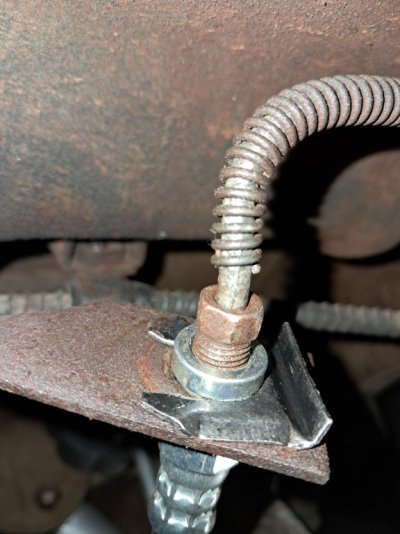
A little surface rust on fittings, but old hose looked OK. Not!
20250910_142951 rear brake hose, collapsed internally.jpg
 
Mistake Report
I removed the safey switch block and applied compressed air across the rear brake passage, no restrictions.
Rear brake had collapsed internally, though externally it looks fine.
This is why it helps to have Mopar friends. I was talking with Wayne and he says, "Did you check the rear brake hose?"
I applied compressed air at the rear brake line off the safety switch block, no flow.
I'm still glad I removed the safety switch block. Much easier to test for flow restrictions on the bench.
Ben
A little surface rust on fittings, but old hose looked OK. Not!

Take the rear distribution block off the rear axle. Disconnect all the lines going to it and take it off the axle. Garanteed that there are bits of the old hose inside it, and they will block the internal ports and passages. Blow it out with air and solvent and use a needle or fine pick. There will be junk in there. It happened to mine for the same reason - I discovered this a few months ago.
 
Take the rear distribution block off the rear axle. Disconnect all the lines going to it and take it off the axle. Garanteed that there are bits of the old hose inside it, and they will block the internal ports and passages. Blow it out with air and solvent and use a needle or fine pick. There will be junk in there. It happened to mine for the same reason - I discovered this a few months ago.
Agree. Time to do some cleaning. Let's see: Remove & replace rear brake hardware, Remove and clean and install wheel cylinders. Clean out axle lines and distribution block. R&R rear brake hose. Safety switch block, Remove, blow out with air, and replace. Replace left front brake line and line from MC rear brake reservoir to safety switch block. Bleed the whole system. Damn, how'd this job get so big?
NAPA rear brake hose 24058 on order. Let's see if it works.
Front disc brake hoses are cake to find. Rear brake hose was hard to find. I could have one made, but that puts the car out of action for a week.
 
Rear Brake Hose

NAPA 24058 is about .15” shorter than the hose I have that collapsed internally

3/8x24 inverted flare brake fitting fits upper end

7/16x20 inverted flare male fitting fits upper end. I measured .3” depth in distribution block. Length of threaded area of hose fitting is .58”. Installs at least .3”.
20250912_112048 NAPA 24058 compared to old hose.jpg
20250912_112059.jpg
20250912_112343.jpg

20250912_112104.jpg
20250912_112137.jpg
 
Take the rear distribution block off the rear axle. Disconnect all the lines going to it and take it off the axle. Garanteed that there are bits of the old hose inside it, and they will block the internal ports and passages. Blow it out with air and solvent and use a needle or fine pick. There will be junk in there. It happened to mine for the same reason - I discovered this a few months ago.
Surprised, but no debris in axle distribution block. All the 3 rear lines were also clear, based on test with compressed air.
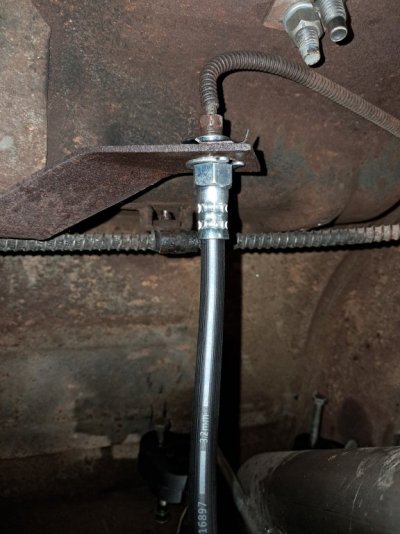
20250912_153947 hose tighten in ADB.jpg20250912_165640 upper rear brake hose installed.jpg20250912_165731 upper rear brake hose installed.jpg20250912_165949 axle distribution block polished and installed.jpg
 
Here's the brake distribution block:

1735.jpg


Unbolt the rear brake valve thingy and you've got this:

1736.jpg


If there's a better replacement for the stock C-body block '67 - '69 or '70 I haven't seen it. Just need to fab a strip of steel to bolt it in the correct position on the frame.

*NO*

*I'm wrong! Read the next post*

If you're swapping in a dual-chamber master cylinder in your '65 - '66 then you need to get this. Or maybe not. This gives you the line failure switch but your car does not have a brake warning light to make use of it. It's probably just as well to run your front lines to a simple 3-way block, and run the rear line directly from the master cylinder.
 
Last edited:

I tried to blow some air through the lower port (the port for the rear brakes). Can't do it.

I take the big bolt out of the bottom of this thing:

1739.jpg


So there's a pressure valve in there. That would explain why this the block has a zig-zag shape. So - take the plunger and spring out, screw the bolt back in, now you've got a 4-wheel drum distribution block.

The other gizmo that was bolted to this - the other brass block with 3 ports, must be for the front? Plumbed in how exactly?
 
Here's some pictures of a 1970 or '71 Chrysler station wagon. It had the Bendix tandem booster and the two piece brass blocks, which was slightly odd to me, having only dealt with the single cast block in the past. I believe the smaller block simply splits the front brakes.

PXL_20221016_184444170.jpg
PXL_20221016_182131567.jpg
Screenshot_20250920-094944~2.jpg
 
I tried to blow some air through the lower port (the port for the rear brakes). Can't do it.

I take the big bolt out of the bottom of this thing:

View attachment 735536

So there's a pressure valve in there. That would explain why this the block has a zig-zag shape. So - take the plunger and spring out, screw the bolt back in, now you've got a 4-wheel drum distribution block.

The other gizmo that was bolted to this - the other brass block with 3 ports, must be for the front? Plumbed in how exactly?
I don't know why it has a spring on one side.
My OEM block has springs and pistons on both sides with a rod between the 2 pistons. As long as pressure both sides it the same, the rod is below the safety switch, and because of the gap between safety switch and rod, the safety switch does not ground. If a pressure decrease occurs, the side with good pressure overcomes the opposite spring and the piston on that good pressure side contacts the safety switch, grounding the circuit and lighting the brake light in the dash.
See diagram post 1
Rod normally below and separated from safety switch is visible in this picture.
20250913_104710 SSB rod between pistons.jpg
 
Back
Top