Great Head light Circuit Upgrade to any Mopar

mr. fix it

Old Man with a Hat
Joined
Aug 14, 2013
Messages
7,767
Reaction score
8,218
Location
Canada
Hi everyone, I found this upgrade article for the headlight circuit which applies to any older car & I know that I will be doing this to my Polara once I get to the point when I am reinstalling the headlights.

I take no credit for this other than posting it here.


http://www.rowand.net/Shop/Tech/WiringHeadlightRelays.htm

There is a great wiring diagram as well on the page.

This will really lessen the electrical load off of the aging head light switch once it's added to the system.

i have performed this technique on a few of my Goldwings when adding high powered HIDS.
Enjoy!
:sunny:

 
Beautiful!
I wanted to hit "THANKS" but.....

It had my head spinning after the first paragraph. This is a 30 minute project, 2 relays and 4' of red wire.
Once again way over complicating a project.


Alan

Maybe this weekend I'll knock it out just to show how simple it should be.
 
It had my head spinning after the first paragraph. This is a 30 minute project, 2 relays and 4' of red wire.
Once again way over complicating a project.


Alan

Maybe this weekend I'll knock it out just to show how simple it should be.


The before and after schematics from the Daniel Stern website (saved me redrawing it)

Before

norelaycircuit.gif

After

relaycircuit.gif
 
The before and after schematics from the Daniel Stern website (saved me redrawing it)

Before


After

relaycircuit.gif

I still have some problems with this.
1. Nothing should come off the alternator, the starter relay is the best place (and not the battery)
2. There is no need for the extra lead with a second fuse, run one wire and jumper the two relays.
3. The diagram, there are people that this diagram will still confuse, it should be consistent and less like a schematic.
4. There are people out there that will think they need to run a wire from the alternator to the battery.

Will it work, yes


Alan
 
I still have some problems with this.
1. Nothing should come off the alternator, the starter relay is the best place (and not the battery)
I've been wondering about where to properly tap off of all my life.
Why do you say at the starter relay?

Btw, he uses two fuses so as to "get you home". I kinda gotta agree with him.
 
I gotta agree with Alan... This is way overcomplicating an easy upgrade.

Two wires with fuses supplying the lights is a good idea though. That would "get you home". I'd use circuit breakers though.

Power can be tapped from the starter relay or battery. Even from the starter if need be, but I don't get why they would tap the alternator. That makes no sense to me at all.
 
If the Alternator was on the driver's side, the same as where the harness to the head lamps are, it may make sense. Running a uber heavy gauge wire across the banks doesn't. Where you tap off of should be as short as possible. I tapped off the alternator when I needed to mount relays on my right fender.
 
The above schematic is how I wired mine. All "power" wires are 12 gauge and all "trigger" wires are 18 gauge. I removed the little wires and connectors that came with the porcelain sockets and replaced them with 12 gauge wires and new connectors. No splices!

Stan: Yes, a back-up. My "High Beam" circuit is wired so that only one side can fail.

I did make a few small changes to the circuits while I was making my harnesses, like one "trigger" circuit per harness instead of two.
 
This is all about voltage drop, all the extra wire and relays just adds it back. I don't think people understand what they are doing and why.

A brand new harness (and no relays) will work as well as these conversions with the old existing wires.

Maybe some demonstrations are in order, I have old and new harnesses.


Alan
 
This is all about voltage drop, all the extra wire and relays just adds it back. I don't think people understand what they are doing and why.

A brand new harness (and no relays) will work as well as these conversions with the old existing wires.

Maybe some demonstrations are in order, I have old and new harnesses.


Alan

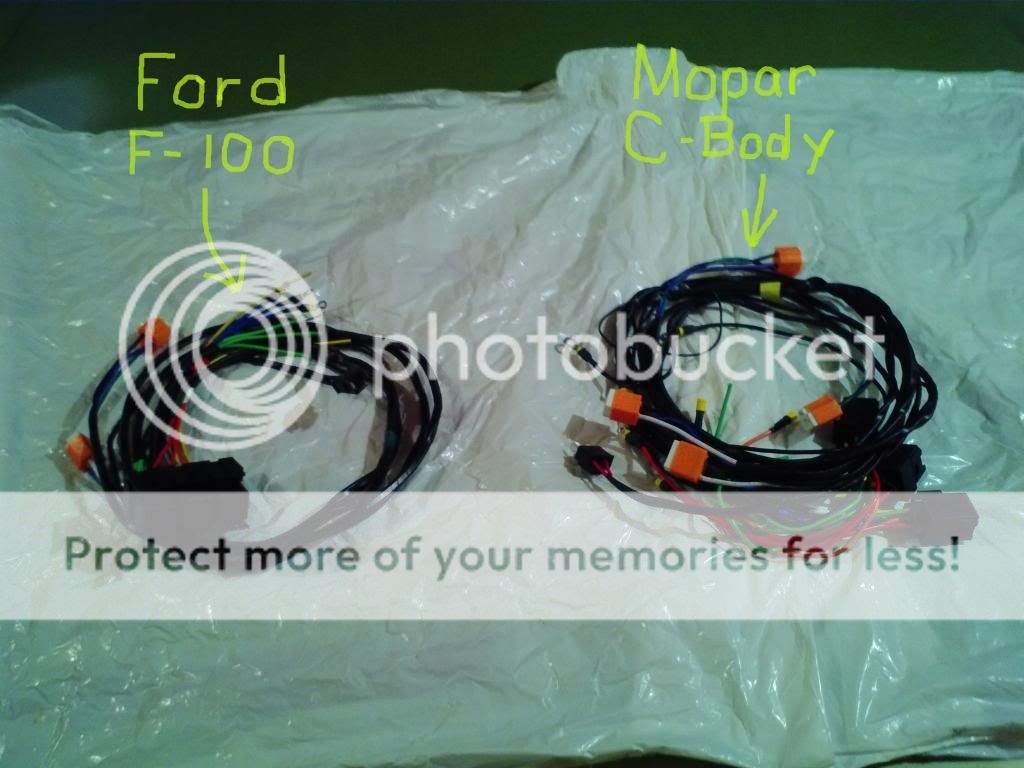
In my case I wasn't trying to make my lights brighter. They were actually very bright already, but my headlight switch couldn't handle the increased amperage drawn by the halogen bulbs. I kept burning out my headlight switches and melted the connector at my floor dimmer switch. The relay circuit is only intended to take the load off my car's existing wiring, in my case. Anyway, here is what I made. In this pic I still had to add a few small connectors to finish them.

095-Copy2.jpg
 
This is all about voltage drop, all the extra wire and relays just adds it back. I don't think people understand what they are doing and why.

A brand new harness (and no relays) will work as well as these conversions with the old existing wires.

Maybe some demonstrations are in order, I have old and new harnesses.


Alan


If you are doing this only to cure dimming lights (voltage drop), then I might agree with the harness theory, but if the reasoning is to help preserve the fragile 40+ year old headlight switch and take some load off the bulkhead connector then relays is the way to go.

*Looks like Wildaugust beat me to it.*
 
You will have less voltage drop going through a relay than you would have going through a fuse block, then headlight switch, then dimmer switch, then the bulk head connector. The contacts in a relay are DESIGNED for high current flow systems. Installing relays on the headlights are beneficial for many reasons as most are already stated. You will have more consistant lighting and you will highly reduce the damage to the switches as well as the bulkhead that has always been a problem on the mopars. I do agree that you typically would be better off with a self resetting circuit breaker instead of a fuse but both have been used and work just fine. it would be more of a matter of preference. The biggest problems with headlights and pretty much anything on cars is grounding. Many people just run a sheet metal screw or a bolt through a hole and don't bother cleaning the paint off of the mating surface where the ring terminal is going to contact the mounting location. 90% of all peoples electrical problems can be related to ground issues in some shape or form. Any of you ever have the turn signal indicators in the dash glow when you turn the park lights on in the car? Guess what is causing that!
 
If you are doing this only to cure dimming lights (voltage drop), then I might agree with the harness theory, but if the reasoning is to help preserve the fragile 40+ year old headlight switch and take some load off the bulkhead connector then relays is the way to go.

*Looks like Wildaugust beat me to it.*

I'm not saying that the halogen bulbs don't draw more current but I have been running them for 30 years with no problems. I will probably do this conversion as it has multiple benefits but simplicity is the key. A properly installed and well maintained system is important. Terminals should be cleaned and dielectric grease put on them, grounds should be to bare metal and not just the thread cutting in.


Alan
 
It had my head spinning after the first paragraph. This is a 30 minute project, 2 relays and 4' of red wire.
Once again way over complicating a project.


Alan

Maybe this weekend I'll knock it out just to show how simple it should be.

Actually after reading his method I started in on my own and did combine wires that did the same job. Found headlight sockets using 12 ga wire with soldered connectors. Real Bosch relays and not Chinese immitations. Then the circuit breaker powered by 10 ga, headlight wires all 12 ga, and trigger wires 18 ga. Powered off the relay in 3 cars so far.
 
Back
Top