Carb rebuilt, engine still hesitates.

NewportTM

Member
Joined
May 6, 2012
Messages
165
Reaction score
22
Location
Central California
I have a Carter 6134-s 2BBL on a 1966 383. I just had the carb rebuilt by Carb-X. The car starts and idles perfect. Put it in gear...no problems. Once you get up to 25 - 30 mph the engine begins to hesitate. It does not die, and when you come to a stop it idles just fine. I have boilded out the tank, used compressed air to clean the fuel line, replaced sending unit, fuel pump, fuel filter and all vacuum lines. PCV valve is good. One part I have not replaced is what I will call the vacuum regulator ( I don`t know the proper name for it). It is located at the back of the engine and all the vacuum lines lead to it. Any suggestions?
 
Does the car have points in the distributer? If so how old ar they? condition and how about the condensor. My car would act up until it back fired and expanded my mufflers. I then replaced the condensor and was fixed.
 
Do you have the original working distributor? If so consider replacing it with the current one at least for testing purposes. As with any problem start with the simple things and work up. It appears you have done all of those. Now perhaps its time to recheck what was replaced/done to double check things out.
 
Could very well be a bad vacuum source, or the carbs not plumed right. Getting manifold vacuum instead of ported vacuum for the vacuum advance on the distributor. But I'm betting it's a timing, and maybe a mechanical, or vacuum advance issue.
 
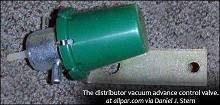
I stumbled across an article this morning. This is a CAP car. This is what the article said about timing.

cap valve.jpg

"The CAP cars’ base ignition timing settings were very retarded compared to the non-CAP cars. A typical non-CAP setting was 2½° to 7½° before top dead center; CAP cars were set at top dead center to 5° after top dead center. The new control valve’s vacuum modulation fixed the sluggish drivability and poor fuel economy that would normally result from such late ignition timing settings."

So I went and checked the timing. It was set at 5 degrees BTDC. I changed it to 5 degrees ATDC and the car runs much better.

cap valve.jpg
 
Back to having the same problem again. Only now it starts at about 50 m.p.h. Since the car does not have to be smogged. I am considering removing the CAP vacuum regulator. Any thoughts on this?
 
Nothing to it but to do it and see. Does the pertronix get full voltage? Ie ballast is bypassed?
 
Does it hesitate when you manually rev the car up in PARK at the carburator? Is it backfiring at all? To me it seems like a fuel issue, like its starving for gas.
 
No hesitation at all when you manually rev the engine. No backfiring. When you kick in passing gear, there is no hesitation or backfire.

Driving down the road, cruising at 50+ m.p.h. it begins to hesitate. Funny thing is, it still gets 20+ mpg.
 
No hesitation at all when you manually rev the engine. No backfiring. When you kick in passing gear, there is no hesitation or backfire.

Driving down the road, cruising at 50+ m.p.h. it begins to hesitate. Funny thing is, it still gets 20+ mpg.

Your car should run worse when retarding the timing 10 degrees, i.e. from 5BTC to 5ATC - at least much more sluggish. What you are describing as hesitating is probably what I call surge, where the engine power is varying at constant vehicle cruise speed. This is usually caused by a very lean cruise condition carburetor calibration. I personally would ditch the CAP valve and set the timing at something like 10BTC (I am not familiar with Petronix but have friends that have had problems with them and went back to the original points distributor). I personally would also get a federal calibration distributor that didn't have the CAP valve system and start from there - CAP package stands for "cleaner air package" and was sold in the state of California where emission rules were more strict than in the rest of the country. The reason the car ran better up to 50 mph instead of 30 mph is because when you retard the timing 10 degrees, you have to stick your foot into the accelerator much more at any speed, and when retarded, even at 30 mph cruise you probably have some enrichment since the vacuum level would be fairly low compared to 5 BTC, so that the surge is stopped until a higher speed when more normal cruise vacuum is again achieved and the cruise air/fuel ratio is back to normal (i.e. lean). Because you are cruising at such a lean condition, that is why you are still getting good fuel economy. There is some chance the carb rebuilder installed too lean a main jet or a different set of metering rods, which leaned out the carburetor at steady state cruise conditions - but I think most rebuilders do not change these. So you first have to sort out the timing (and is your vacuum advance hooked up - what distributor are you running then?). Too many unknowns from what you have written to better isolate your problem. But at least I am pretty sure it is lean surge you are feeling. If it were me I would get the non-CAP distributor as indicated above and the carburetor that went with it, which should be available from any non-California car. Then it would run right. Surge was a common complaint on CAP cars.
 
If it were running lean, would he be able to pull a plug and notice the effects of running lean?
 
If it were running lean, would he be able to pull a plug and notice the effects of running lean?

That might be possible assuming the engine does not use any significant oil from worn rings or cracked valve guide seals etc. They should look light colored rather than dark colored if the engine is running lean under cruise conditions, assuming he drives enough freeway speeds in his daily driving. If he has short trips and multiple cold starts in a day, then it might not be noticeable.
 
Update.......replaced the fuel pump push rod and it is now running much better. Old push rod is a about 3/16 shorter than the new one. Set timing at 7 degrees BTDC. Cruises along just fine now.
 
Put a light on it, and see if the timing is jumping around, first at idle, then at 3,000 or so. If it is, those notoriously crappy timing chains
used then is causing an Issue. 383 engines then would first hesitate at speed, then eventually at an Idle. I had to replace a bunch of them in the 70's. Try driving it with the vacuum advance plugged. it may give you a better indication of what it is doing. I also did more than a few valve jobs after the engine jumped time, and bent valves. I'm not trying to make the problem look bigger than it is, but this was a common malady back then.
 
Update.......replaced the fuel pump push rod and it is now running much better. Old push rod is a about 3/16 shorter than the new one. Set timing at 7 degrees BTDC. Cruises along just fine now.
The fuel pump push rod is an item that normally dosen't wear significantly, that coupled with your original dist shaft being worn might signify a worn timing chain and/or gear set.
Look at the timing mark with a timing light, it should be pretty steady. It it is fluctuating then that could indicate worn timing gears/chain, and
That could explane some of the eratic performance.
 
Put a light on it, and see if the timing is jumping around, first at idle, then at 3,000 or so. If it is, those notoriously crappy timing chains
used then is causing an Issue.QUOTE]
LOL ........ Ya beat me to it by a minute...... I'm thinking that is his problem though, espically if the cam gear has nylon teeth. I've changed a few too.
 
I drove it on a 400 mile trip over the weekend. It was starting fine when I left. Now very difficult to start. Once it`s running,the timing mark is bouncing all over. Purchased timing gear set and gaskets today. Goes in the shop Monday to have the timing chain replaced.
 
Back
Top