65 Sport Fury 383 Carb recommendation

routeman71

New Member
Joined
Jan 25, 2024
Messages
39
Reaction score
36
Location
NC
Hi all,
I have a fairly stock 383 all but the aluminum Edelbrock intake . I ran a dual line Hokkey 650 for years, which would carry the car for a heck of a ride. Currently have a Holley 600 on it, which runs great, but is missing that punch at takeoff . Looking at Edelbrock 750 to possibly getting the punch back . Would a 750 be too much? Recommendations appreciated
Thanks
 
A lot of the guy's really like the Edelbrock 1406 it's a 600cfm, but seems to work great even on stock 440's. My father in law has one on his 65 Sport Fury with a 383, it was on it when he bought it and it runs good
 
Carb size has LITTLE to do with "off-line punch". That is the accel pump's domain, usually. Look at how the earlier carb was calibrated in that respect and seek to emulate that with the current carb. With a Holley 4bbl, it is the accel pump cam (of which there are MANY, in a kit) and then the accel pump shooter (which has varying diameters of holes to "dump" or "shoot" the fuel into the venturis. LOTS to play with, which is why emulating the earlier carb's accel pump performance is necessary.

The accel pumps on the Holleys are very precise and accurate. The Edelbrocks don't have quite that tunability, but it might be that they don't really need it.

Now for the "perception" part . . . in many cases, we tend to remember how good things used to be or were, but when we seek to "rebuild" those memories, those efforts typically fall short. Which is both depressing and disappointing at the same time. Whether in work, cars, or life in general. Sometimes, it is best to let great memories remain great memories, from my observations.

I'm not really sure what kind of "punch" you might be looking for. "Tire smoking" off-idle performance or strong "push you back in the seat" performance. If the former, maybe just some less-sticky tires would do it? For the latter, just the opposite, so that the front end lifts as the car "leaves".

In case you look at the current offerings of new Holleys, you might not find the old carb you used to have. IF you do, it still could be different in many respects.

Just some thoughts and observations,
CBODY67
 
Carb size has LITTLE to do with "off-line punch". That is the accel pump's domain, usually. Look at how the earlier carb was calibrated in that respect and seek to emulate that with the current carb. With a Holley 4bbl, it is the accel pump cam (of which there are MANY, in a kit) and then the accel pump shooter (which has varying diameters of holes to "dump" or "shoot" the fuel into the venturis. LOTS to play with, which is why emulating the earlier carb's accel pump performance is necessary.

The accel pumps on the Holleys are very precise and accurate. The Edelbrocks don't have quite that tunability, but it might be that they don't really need it.

Now for the "perception" part . . . in many cases, we tend to remember how good things used to be or were, but when we seek to "rebuild" those memories, those efforts typically fall short. Which is both depressing and disappointing at the same time. Whether in work, cars, or life in general. Sometimes, it is best to let great memories remain great memories, from my observations.

I'm not really sure what kind of "punch" you might be looking for. "Tire smoking" off-idle performance or strong "push you back in the seat" performance. If the former, maybe just some less-sticky tires would do it? For the latter, just the opposite, so that the front end lifts as the car "leaves".

In case you look at the current offerings of new Holleys, you might not find the old carb you used to have. IF you do, it still could be different in many respects.

Just some thoughts and observations,
CBODY67
Thanks for the lengthy reply. I totally get what you are saying. If it ain't broke, don't fix it. The car starts , runs, and top ends beautifully, which is why i am hesitant to mess with it. What i am missing most is with the old carb, i could kick it from a dead stop and it would spin tires easily. If i really kicked it, it would start fish tailing. Now when i punch it at a stop, it just goes, no spin, no fanfare, like it doesn't have quite enough fuel at takeoff to do what i am wanting to do. It doesn't bog necessarily, just seems slow to respond if that makes sense. Maybe it is a tuning issue, which is another ball of wax as i am not versed in carb tuning and most of the carb guys around here are too old to work on them or have passed on. Thanks again for the input
 
Thanks for the clarifications.

Back in 1975, when I bought my '70 Monaco Brougham 4drht, with the 383 "N" "High-Performance" (Chrysler terminology) motor, I also had a friend in college that had a '69 Super Bee. The Bee was stock, but had the OEM Holley 4160 on it. He had drag raced it, so he had a cigar box full of extra gaskets, with some jets and power valves left over from carb kits. Same 3.23 gears as was in the Monaco.

I was always impressed with the sharpness of off-idle throttle response from the Holley. No matter what I did, I could not get that same sharpness out of the OEM AVS on the Monaco. I did try to no avail. At a car wash, with the damp concrete, it was easy for him to spin his G60-14 rear tires. The Monaco could not do that. Yet, on the road, at 75mph cruise, I could get 16.5mpg as he usually got 15mpg. So I was happy, whether I wanted to be or not. His car also had factory a/c as did the Monaco.

Now, the Bee had F70-14 frt and G60-14 rr tires on slot aluminum mags. With the different aspect ratios, the car sat level, as it should have anyway, but with the "drag strip" look of skinnier front tires and wider rear tires. Bias-ply, white letter tires. My Monaco had Pirelli P76 radials, JR78x15 all around. So I had "more traction" due to the better tread contact and a bit heavier weight. With the "N" engine came the smaller 10.75" torque converter, so a higher stall speed, similar to a '68 Road Runner engine.

Back in 1968, a friend who lived next door to us, ordered a new '68 Satellite 2dr ht, with the 383 4bbl V-8. It looked to all the world to be the Road Runner 383 (open element air cleaner, high-rise exhaust manifolds) with factory a/c. It had the stock 7.35x14 Goodyear bias-ply tires of the time. It would easily spin the rear wheels with "more" throttle input. 3.23 gears, too. Tire tread width was probably in the 5.0" range? So, it definitely needed more tread on the ground, but that would have killed the "stock" look with wheel covers on it. So he learned to drive it better, with good results in the weekend "main drag" contests on the main drag street in town.

In the road test that "CAR AND DRIVER" did of the 1968 Barracuda 340-S car, they noted that with the factory D70x14 Goodyear tires, the car probably had too much traction. Seems they tried to "lay rubber" with it, but only got chirps instead. Once used to that, they also noted how fast the car was when it didn't spin the rear wheels. Besting most of the other competitors in its field. Plus some other larger cars with bigger engines, too. So they came to enjoy the "no drama" (as we might now term it) situation. Just tromp it and hang on to setter, basically. Otherwise, it just worked.

In one respect, spinning rear tires (and related tire smoke) has been besmirched by modern cars. Smokey doughnuts in "street takeovers" at intersections, to show off AND the many late model Mustang exploits on YouTube, where the car lays rubber, starts to fishtail, (AS the driver fails to get out of the throttle!!) and crashes/property damage results. As if THAT is a badge of honor for them? So, laying rubber can still be fun, but in a straight line! Hopefully, with two black stripes rather than just one.

I understand the "carb guys" not being around any more. This can be good and it can be bad. If you look at some of the carb tuning articles from back in about 1968 in the magazines, it was about "richer main jets" (even pre-emission), "blocked power valves" (in Holleys), pure mechanical advance in the distributor, faster mechanical advance, and more initial spark advance settings. Then with drag strip results. But those who did the same things on their cars usually got the power they desired, but image of having doing these "race" things to their car, but with higher fuel costs. Others finessed the Holley metering block orifices a bit, kept the power valve operational, might have limited the amount of vac advance, and got similar results in their more-sophisticared work. My orientation was more like quicken the mechanical advance, keeping the vac advance for cruise economy, and THEN adjust the main jets if the spark plugs indicated things were a bit too lean. If it clattered on premium fuel, back off the timing a bit. Otherwise "fiddlin' and tweaking" . . .

Take care,
CBODY67

 
Thanks for the clarifications.

Back in 1975, when I bought my '70 Monaco Brougham 4drht, with the 383 "N" "High-Performance" (Chrysler terminology) motor, I also had a friend in college that had a '69 Super Bee. The Bee was stock, but had the OEM Holley 4160 on it. He had drag raced it, so he had a cigar box full of extra gaskets, with some jets and power valves left over from carb kits. Same 3.23 gears as was in the Monaco.

I was always impressed with the sharpness of off-idle throttle response from the Holley. No matter what I did, I could not get that same sharpness out of the OEM AVS on the Monaco. I did try to no avail. At a car wash, with the damp concrete, it was easy for him to spin his G60-14 rear tires. The Monaco could not do that. Yet, on the road, at 75mph cruise, I could get 16.5mpg as he usually got 15mpg. So I was happy, whether I wanted to be or not. His car also had factory a/c as did the Monaco.

Now, the Bee had F70-14 frt and G60-14 rr tires on slot aluminum mags. With the different aspect ratios, the car sat level, as it should have anyway, but with the "drag strip" look of skinnier front tires and wider rear tires. Bias-ply, white letter tires. My Monaco had Pirelli P76 radials, JR78x15 all around. So I had "more traction" due to the better tread contact and a bit heavier weight. With the "N" engine came the smaller 10.75" torque converter, so a higher stall speed, similar to a '68 Road Runner engine.

Back in 1968, a friend who lived next door to us, ordered a new '68 Satellite 2dr ht, with the 383 4bbl V-8. It looked to all the world to be the Road Runner 383 (open element air cleaner, high-rise exhaust manifolds) with factory a/c. It had the stock 7.35x14 Goodyear bias-ply tires of the time. It would easily spin the rear wheels with "more" throttle input. 3.23 gears, too. Tire tread width was probably in the 5.0" range? So, it definitely needed more tread on the ground, but that would have killed the "stock" look with wheel covers on it. So he learned to drive it better, with good results in the weekend "main drag" contests on the main drag street in town.

In the road test that "CAR AND DRIVER" did of the 1968 Barracuda 340-S car, they noted that with the factory D70x14 Goodyear tires, the car probably had too much traction. Seems they tried to "lay rubber" with it, but only got chirps instead. Once used to that, they also noted how fast the car was when it didn't spin the rear wheels. Besting most of the other competitors in its field. Plus some other larger cars with bigger engines, too. So they came to enjoy the "no drama" (as we might now term it) situation. Just tromp it and hang on to setter, basically. Otherwise, it just worked.

In one respect, spinning rear tires (and related tire smoke) has been besmirched by modern cars. Smokey doughnuts in "street takeovers" at intersections, to show off AND the many late model Mustang exploits on YouTube, where the car lays rubber, starts to fishtail, (AS the driver fails to get out of the throttle!!) and crashes/property damage results. As if THAT is a badge of honor for them? So, laying rubber can still be fun, but in a straight line! Hopefully, with two black stripes rather than just one.

I understand the "carb guys" not being around any more. This can be good and it can be bad. If you look at some of the carb tuning articles from back in about 1968 in the magazines, it was about "richer main jets" (even pre-emission), "blocked power valves" (in Holleys), pure mechanical advance in the distributor, faster mechanical advance, and more initial spark advance settings. Then with drag strip results. But those who did the same things on their cars usually got the power they desired, but image of having doing these "race" things to their car, but with higher fuel costs. Others finessed the Holley metering block orifices a bit, kept the power valve operational, might have limited the amount of vac advance, and got similar results in their more-sophisticared work. My orientation was more like quicken the mechanical advance, keeping the vac advance for cruise economy, and THEN adjust the main jets if the spark plugs indicated things were a bit too lean. If it clattered on premium fuel, back off the timing a bit. Otherwise "fiddlin' and tweaking" . . .

Take care,
CBODY67
Very good info. As i do not use the car for racing, i am not interested in messing up a good thing just to get my occasionally show off jollies . The car is babied 99% of the time. It is just frustrating knowing that at one time i could kick it sideways if i wanted. I have been doing some research and i may try to swap the accelerator nozzle to a little bigger size just to see if it makes a difference. Seems like a cheap and easy solution if it works. If not, i can go back to what i had with no real changes
 
Hi all,
I have a fairly stock 383 all but the aluminum Edelbrock intake . I ran a dual line Hokkey 650 for years, which would carry the car for a heck of a ride. Currently have a Holley 600 on it, which runs great, but is missing that punch at takeoff . Looking at Edelbrock 750 to possibly getting the punch back . Would a 750 be too much? Recommendations appreciated
Thanks
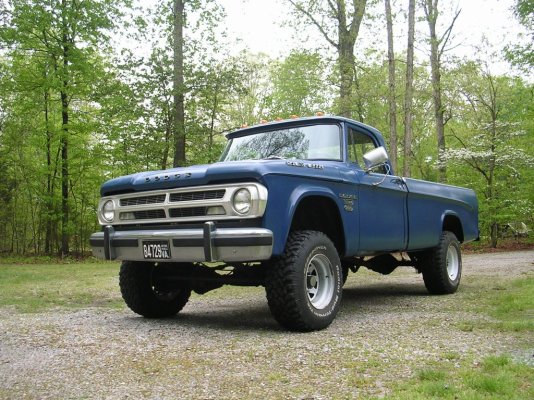
I ran a Holley 750 Vacuum secondary on a 360 V8 with 4-speed granny gear and 4.10 rears.
My 1967 Power Wagon would pass everything but a gas station.
You can go bigger on cfm, but there are trade-offs.
(1970/71 grill cause I liked it.)
DSCN4193.JPG
 
Used Edelbrock carbs can be had pretty reasonable so try one out. 650 AVS or a 1407 750 performer should do the trick.
 
Back
Top